By CHUCK OFFENBURGER
JEFFERSON, Iowa, March 7, 2026 — Oh, the lessons we are learning together! “We” are dozens of Iowa history students at Greene County High School here and a group of adults serving with students on a “Schoolboy Soldiers of Rippey Memorial Committee.”
Please take time for this update.
We are researching and re-presenting a fascinating but almost-totally-forgotten 165-year-old episode of local history —how 32 young pioneer men who’d been the first students in one of our county’s first schools and their 2 teachers enlisted in the Union Army and marched off to service in the Civil War. Eleven of them died in combat or from war-related illnesses.


Teacher Dena Boyd and sophomore Taylor Ross at the grave of Civil War soldier John H. Toliver, the first of the “Schoolboy Soldiers of Rippey” who died in the Civil War. It is the epitaph from his tombstone that is quoted in this column.
We’ve been at this for nearly a year now, going back to last April when the high school’s Iowa history teacher, Dena Boyd, asked me to talk about local history with her students, “especially any stories that might be impactful to high school students today,” she said.
When I told them about the “Schoolboy Soldiers of Rippey,” as I nicknamed them, the students of today were clearly shocked. None had ever heard the story, and one reason they hadn’t is because there has been no public monument explaining it. Their response: “Could we still have one made?” And, “Would you help us?”
As I said, we are researching, together, so we can soon begin re-presenting the story to the public, in several different ways. And this past week was a big one for us.
On Monday, the Greene County Board of Supervisors, who earlier pledged a $5,000 donation to our project, formally approved a resolution allowing our committee to purchase, design and have erected a 9-foot-tall monument on the lawn of the courthouse in Jefferson.
On Wednesday, we learned that our application for a $22,713 grant for 34 replica Union Army uniforms, accessories, a fife, a drum, a banner and a 6-by-10-foot cargo trailer to haul all the above, was declined by a local foundation. We understood — the foundation’s board was overwhelmed with requests for other good projects — but still, we were stunned. We will raise that money from other sources.
On Thursday morning, we deposited $2,000 in additional contributions from local people. We accepted a friendly $10,000 loan from the Greene County Development Corporation, our local economic development group. We drained our committee’s treasury. And we made a required $18,566.06 downpayment to our local Jefferson Monument Works for two identical 9-foot-tall, student-designed monuments memorializing the story of the Schoolboy Soldiers of Rippey.
One monument will go on the Courthouse lawn. The other will go in the Old Rippey Cemetery, very near the site of the pioneer school where the soldiers of so long ago first met. We also signed an agreement that on May 5, we will pay the balance due on the monuments, $37,132.10, and we are already at work seeking support from several potential donors.


Greene County High School students in the Iowa history class visit the grave of another of the Schoolboy Soldiers of Rippey, Van Buren Branch, in the Old Rippey Cemetery.
The finances had me a little shell-shocked by Thursday afternoon, yet I remain ever-confident from my lifelong experience, that in Iowa there is always money and support for good projects.
And right then, about 15 Iowa history students from Greene County High School and a half-dozen of us adults supporting them got another good lesson from the teacher Dena Boyd.
She and Dianne Piepel, co-executive director and lead researcher for the county historical society, have been leading the students in learning about the lives and deaths of the 34 Schoolboy Soldiers of Rippey. The students of today will be portraying the soldiers at upcoming public events.
Thursday afternoon, we rode a school bus to four different local cemeteries where 10 of our schoolboy soldiers and their lead teacher Azor Mills are buried. The trip required some skillful, back-roads navigating, handled so well by bus driver Shawn DeMoss. “This is sort of my briar patch,” DeMoss explained, pointing toward a farmstead northwest of Rippey where he’d grown up.
At the graves, students of today who will portray the soldier buried there stood in uniform, recited what they’d learned so far about the soldier, and posed for photos. Much of it was videotaped by Iowa PBS TV’s senior producer & director Theresa Knight and videographer Mark Haugen, who are preparing a story on our project.
There were a few laughs and smiles, of course, but there was much more silence, reverence, respect.


Student Roman Sebourn (left), a high school junior, and David Burkett, both members of our memorial committee, leave the Rippey Cemetery after visiting the grave of Archibald Burk, one of the Schoolboy Soldiers of Rippey. Both Sebourn and Burkett are Civil War re-enactors. Burkett is carring a musket that was actually used in the Civil War.
An example was at the Old Rippey Cemetery, when we all stood at the grave of John H. Toliver, the first of the schoolboy soldiers who died in the war — on Nov. 26, 1862 — from an epidemic of measles that had swept through the military ranks in combat across the South.
Dianne Piepel, the researcher for the historical student, noted that the high school students “have been studying the schoolboy soldiers for a while now,” and it was moving “to see them at the Old Rippey Cemetery and taking in the fact that they were standing at the grave of a schoolboy soldier who made the greatest sacrifice when he left his wife, son and baby-on-the-way to join the 39th Iowa Infantry to fight for his country.”
Maybe even more moving was when Dena Boyd pointed out that the tombstone has an epitaph that the more than 160 years are threatening to erase. She read it out loud to the students:
“Sleep on, sweet one, and take thy rest.
God called thee home, he thought it best.”
It got real quiet in our group right then.
The thought of visiting the graves of our schoolboy soldiers last week inspired a poem by Jed Magee, a retired Iowa District Court judge and poet who is a member of our memorial committee. He calls it “Ode to Student Soldiers of Old Rippey,” and here it is:
They were young
They were naive
Products of true pioneers
From a nascent state
Infused with national fervor
Part of the largest per capita
Response of any state
To be part of a sectional strife
In exotic places like
Corinth, Shiloh, Vicksburg
From which some never returned
Laid to rest beneath southern soil
Now never to be forgotten
Their story will be told by students of today in Civil War uniforms; in parades, public services and programs; on two large monuments soon to be on public display; in a school play to be performed next November at Greene County High School, and possibly in public murals in the county.
We are also now officially registered as one of Iowa’s “America 250” events, celebrating the nation’s anniversary in this year of 2026.
The Schoolboy Soldiers of Rippey, as Magee wrote, are “now never to be forgotten.”
You all can help us, too, by writing checks to the Greene County Historical Society, which is a 501.c3 tax-exempt non-profit corporation that is serving as our fiscal agent. Designate that your donations are for the “Schoolboy Soldiers of Rippey” memorials. Mail them to the historical society at its museum, 219 E. Lincoln Way, Box 435, Jefferson IA 50129.


Iowa history teacher Dena Boyd, aboard the school bus making stops at the graves of Schoolboy Soldiers of Rippey, in four different cemeteries — Rippey, Old Rippey, Pleasant Hill and Jefferson.


Rylan Hostetler, a freshman, at the grave of soldier James Smith.


Mia Murphy, sophomore, at the grave of soldiers & brothers Henry & Joseph Myers in the Jefferson Cemetery.


Sam Fitzpatrick, a sophomore, at the grave of soldier Van Buren Branch. Different spellings of some of the soldiers’ names have been found in military and newspaper records. Branch may have actually had the last name of Brand. “Because we’re looking back at records from 160 years ago, we’ve found some discrepancies,” said teacher Dena Boyd.


Lila Osterson, a senior, portrays soldier Gillum Toliver. She is also the artist who is doing a portrait of a Schoolboy Soldier that will be featured on the 9-foot-tall monuments.


Ethan Thompson, a sophomore, at the grave of soldier Goldsbrow Burk at Pleasant Hill.


Brystol Hamann, a freshman, at the grave of soldier John B. John at Pleasant Hill Cemetery.


Roman Sebourn, a junior, at the grave of soldier John Myers in Jefferson.


Lily Ellis, a freshman, at the grave of soldier Joseph R. Myers.
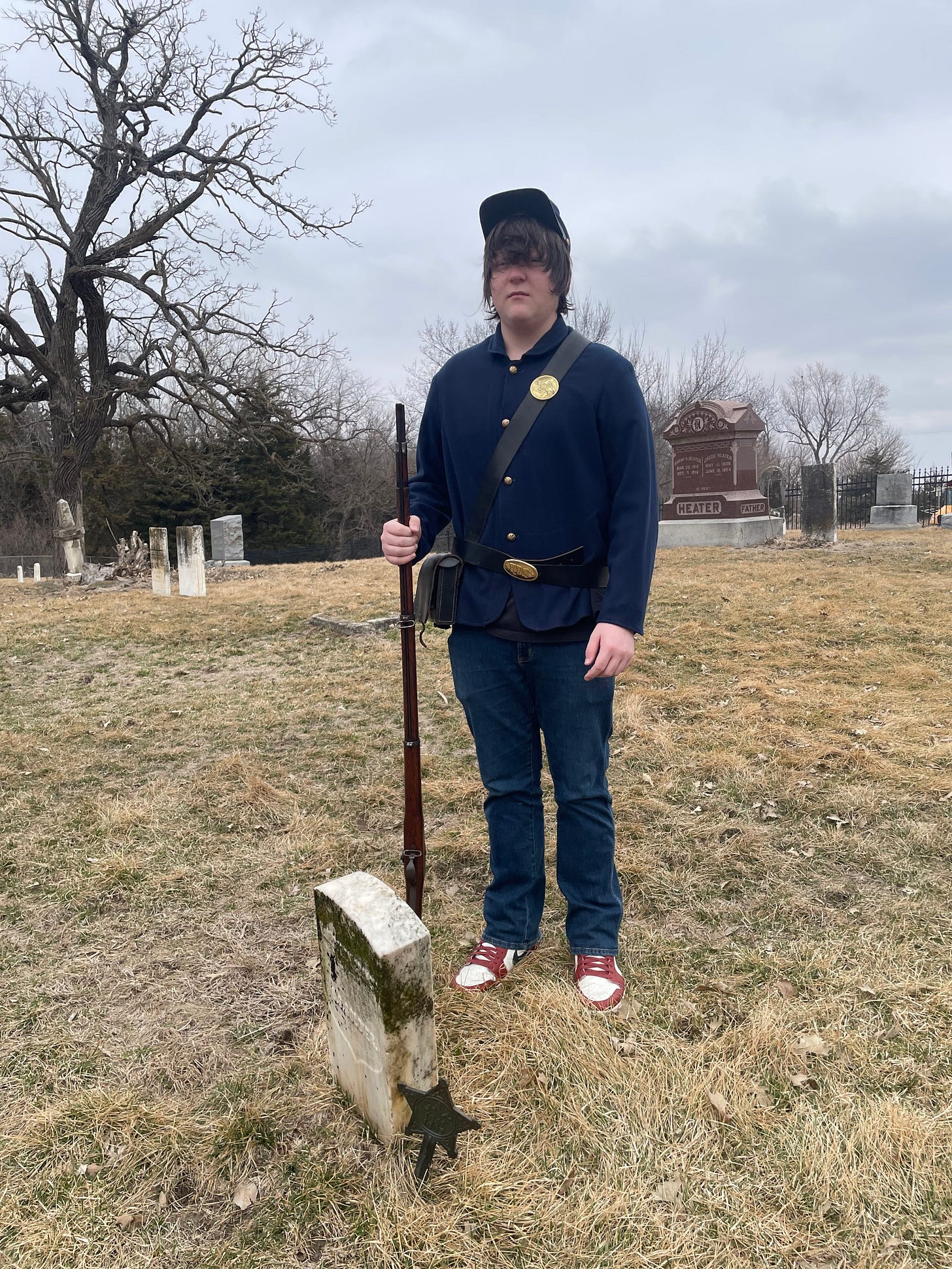
Matthew Price, a freshman, at the grave of soldier Van Buren Branch in the Old Rippey Cemetery.
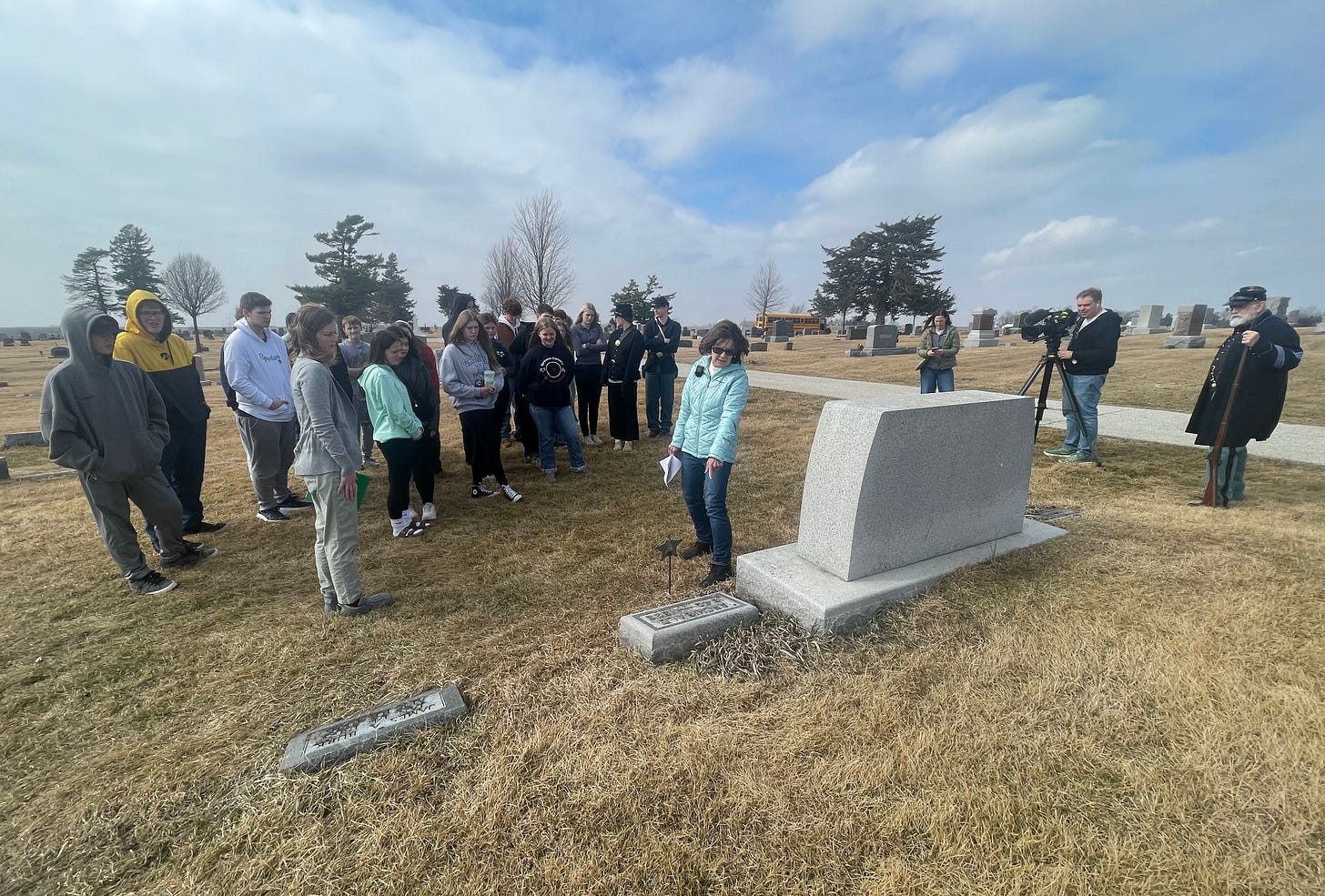
Dianne Piepel, of the Greene County Historical Society, points out details on the grave of soldier Archibald Burk in the Rippey Cemetery.

David Burkett, of Scranton, a member of the Schoolboy Soldiers of Rippey Memorial Committee, uniformed up and displayed his genuine Civil War musket during the visit to four cemeteries in Greene County.


Scott O’Neal, a freshman, is a member of the “Woods Tech” class at Greene County High School that is making about 30 wood representations of rifles that the Schoolboy Soldiers of Rippey re-enactment unit will carry in public appearances.
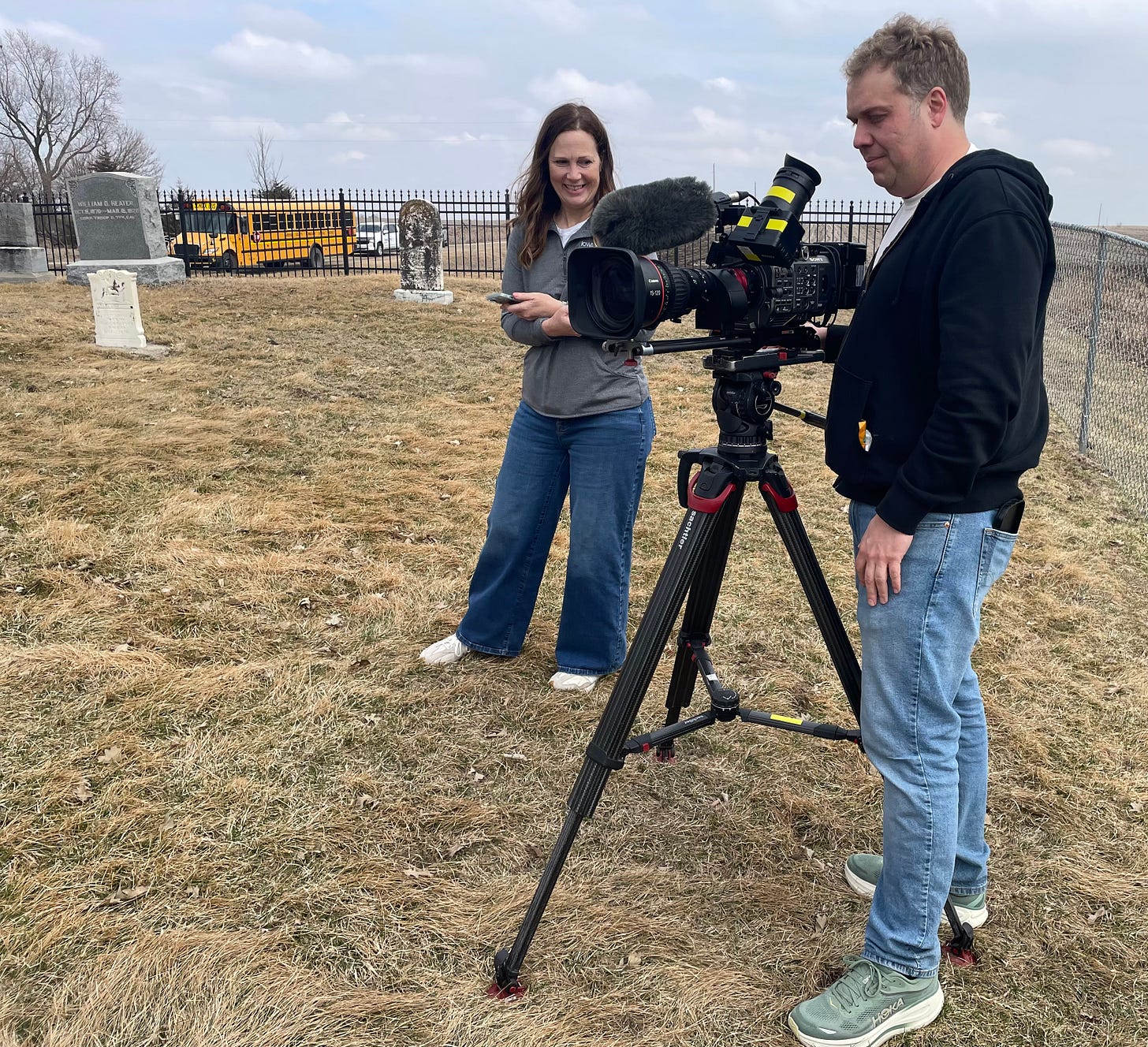
Theresa Knight and Mark Haugen of Iowa PBS TV joined the students and committee members for the cemeteries tour. (Photos by Chuck Offenburger, Margaret Hamilton and Dena Boyd)
—
You can comment on this column below or write the columnist directly by email at chuck@offenburger.com.


Great story and great pictures.