By CHUCK OFFENBURGER
SHENANDOAH, Iowa, Sept. 13, 2026 — “This is not your grandpa’s funeral,” Bill Hillman said to a crowd of about 50 people gathered on a hot, sunny, Sunday afternoon in a large tent on the lawn of his Depot Restaurant & Lounge here in my ol’ hometown in southwest Iowa. “I really appreciate all of you who show up and help. I don’t know if this is normal.”
It was a memorial service, led by a dozen musicians, “for one of Shenandoah’s favorite sons,” as the printed program called Willis David Hoover.
He was a guitar virtuoso, singer and songwriter who was one of country music’s “Outlaws” in the late 1960s and whose songs were recorded by such stars as Waylon Jennings, Eddy Arnold and Tina Turner. Two of his best-known songs are “Freedom to Stay” and “All That Keeps Ya Goin’.”
“Hoover,” as most knew him, was an excellent photographer, mayoral press secretary, newspaper feature writer and columnist, occasional rascal, “Uncle Wonderful” to his nieces, and a great husband when he finally got around to marriage to Cari White later in his life. Major talent in so many different ways. On balance, a really good guy and a caring, sharing human being.


Old friends in Shenandoah, Bill Hillman (left) and Willis David Hoover, in a 2019 visit at Hillman’s restaurant & lounge, which is decorated with priceless music memorabilia. (Photo courtesy of Bill Hillman)
He died at 80 years old on Aug. 3 in Hawaii, after a decade fighting cancer. He lived on the islands his last 35 years or so as one of that state’s favorite newspaper columnists, mostly for the Honolulu newspapers. Earlier in his career, he roamed Iowa writing features for the Des Moines Register and briefly succeeded the legendary Donald Kaul as author of the Register’s “Over The Coffee” column.
So there we all were in the tent on Aug. 30.
Business & community leader Kim Gee began the service with words of spiritual comfort. She said specifically of Hoover, “If you listen to his songs, and think about the lyrics, he does capture life.”
Then I suddenly heard restaurateur Hillman telling the crowd, “I’ve always thought Shenandoah has had two great storytellers. We’re here today to pay tribute to Willis David Hoover, who with his music and stories was one of them” Then he pointed at me and said, “The other one is sitting right over there, Chuck Offenburger, and he’ll be up here in a few minutes to tell you a few stories about his lifelong friend Hoover.”
Well, OK now.
Let’s see, did I first meet Hoover when we were singing in the Shenandoah High School mixed chorus? He was a year ahead of me and graduated in 1964.
So, no, it was earlier than that.
In our younger high school years, I must’ve met him in the “dark room” (remember those?) in the downtown building that was home to The Evening Sentinel newspaper, Iowan magazine and Living History Publications, where we both would’ve been breaking all the child labor laws, if there’d been any. But we learned photography, picture processing, platemaking and journalism. And we became good buddies.
After high school, Hoover started college at Southwest Missouri State University, and spent a year mostly majoring in guitar playing and singing wherever he could.


Bill Hillman, with a cut-out of Willis David Hoover performing later in life, and holding Hoover’s first record album. This was on the stage in the tent at the Aug. 30 memorial service.
Back home in Shenandoah, at KFNF radio, it probably was deejay Ronn King (“Ronn The Melody King”), another of our friends, who helped Hoover record a few songs and send them to several recording studios around the nation. One, the Glaser Studios, home of “Tompall & the Glaser Brothers,” invited him to come give the music business a try in Nashville, Tennessee.
And that was right when I was starting my freshman year at Vanderbilt University, also in Nashville, Tennessee.
We continued our friendship there, and occasionally, Hoover and I would get together for lunches or dinners and then an evening with his new friends in music. And I’d drop by and test my skills at a pinball parlor where he worked in a side gig.
So maybe I should’ve started my Hoover tribute recalling a night when, in a small apartment he had rented across 21st Avenue and just east of the Vandy campus, a group of his music pals and I all met up. We pooled what little money we had, bought several glass quart bottles of Schlitz and Pabst Blue Ribbon beer, and had a big time.
I remember a lot of storytelling that night, but not any singing. I should have asked for some, because the group included Kris Kristofferson, John Hartford, Kinky Friedman, and was Glen Campbell there? He was often around. I seem to recall the group loving my stories about what Hoover had been like in high school.
Right then, all of us shared three things — poverty, some talent and big ambitions.


Jeff Slater, of Shenandoah, telling the crowd at the memorial service that he was about to sing Hoover’s “Freedom to Stay.”
Late in my sophomore year, with major financial help from my mother Anna Offenburger, I bought a used Volkswagen “bug” in Shenandoah. Hoover did not have wheels then, so he shared mine, especially at holiday times, for rides back and forth between Nashville and Shenandoah.
That VW had no heat, air conditioning or radio, so those trips that were 800 miles each way, seemed really long. But Hoover brought his guitar, I brought a football, and we’d break the boredom with sing-alongs and stops to throw around the football.
One of those 16-18 hour trips I’ll never forget was Nashville to Shenandoah through the night June 5-6, 1968. When we arrived in “Shen,” about 6 a.m., I dropped off Hoover at the home of his parents, Willis and Ellen Hoover. I drove to Mom’s house, woke her up to say hello, then collapsed in my old bed. Minutes later, the phone rang, Mom was downstairs to answer it, then yelled up to me, “Bill Hoover is calling and says it’s important!”
When I picked up the phone, Hoover said, “Have you got TV or radio turned on there?”
“No,” I said. “What’s up?”
“Bobby Kennedy was assassinated during the night in Los Angeles.”
I nearly fainted at this awful news, especially that it came just two months after the assassination of another of my heroes, Rev. Martin Luther King Jr. I remember being barely able to talk.
“Are you OK?” Hoover finally asked.
All I could get out was, “I don’t know. I just don’t know.”
I’m not sure I know yet. How in the hell did all that happen? Have we ever really been OK since then?
But life went on for most of us.


John Scherle, of Henderson, Iowa, joined the tribute to Willis David Hoover, recalling that Hoover was a mentor to Scherle and many other young musicians in southwest Iowa.
Hoover and I were close again in the late 1970s and early ’80s when he did his freelance work and column writing for the Register, at the same time when I was building my Iowa Boy column. Some memorable Hoover-isms from then:
—When I was whining about being in a writing slump and unable to produce the prose I needed to get a column started: “What?” Hoover barked at me, as he picked up an ashtray between us. “You can even make an ashtray interesting. Write the damned thing!”
—When some public official was avoiding our questions, I suggested he was innocent of our suspicions, but Hoover wasn’t buying it. “From all my years in the music business,” he said, “I can smell ‘fart-off’ from a mile away!”
—When my phone rang one day in the Register newsroom, I picked it up and heard Hoover calling from the Iowa countryside. “You won’t believe where in the dickens I am,” he said. OK, where are you, I asked. “Dickens, Iowa,” he said from up near the Iowa Great Lakes. Oh. (Pardon the humor among guys from Shenandoah, Iowa.)
Obviously, I’ll never forget him.
Here’s something else I’ll never forget — the most wonderful thing about the memorial service for Hoover in Shenandoah — the dozen musicians singing in tribute to him. They ranged in age from 20 to some old rockers in their 70s, all of them waaaay better than your typical small-town singers and pickers.
And you know, it’s long been that way in my ol’ hometown.


Dan Sullivan and Becky Braun, who were part of the top-notch regional rock band “High Heel & the Sneekers,” were back together performing in tribute to Willis David Hoover. Both now live in Shenandoah.


John Rogers, of Omaha, another alumnus of the fine rock band “High Heel & the Sneekers,” joined in honoring Willis David Hoover.
In the 1920s, when seed & nursery entrepreneurs Henry Field and Earl May started their radio stations — KFNF and KMA — in Shenandoah to advertise and promote their seeds, flowers, shrubs, trees and more, they figured out they needed to have entertainers to fill the time between commercials, news, sports and weather reports.
So over the next 30 years, they hired 100 or more very promising, mostly-young musicians to come live in Shenandoah for a time. They’d all do daily shows, sing commercials and make personal appearances at public events around the four-state area their radio signals covered.
What a roster they had at different times over the years: Bill Monroe (“the Father of Bluegrass Music”), Al Sloey & the Riders of the Purple Sage, the Blackwood Brothers, Charlie Haden, Lefty Frizzell, Yodlin’ Bob Stotts, the Ed May Quartet, and most renowned of all, “Cousin Ike Everly, my wife Margaret and our boys Don and Phil.” Yes, those boys became the Everly Brothers, charter inductees of the Rock ‘n’ Roll Hall of Fame.
I saw a lot of those entertainers in my own boyhood. In the early 1950s, before the “live radio” era was ending, my parents would take me and my infant sister to the separate 1,000-seat auditoriums where KMA and KFNF had their studios on stage. The public was invited to sit in the theater-like seats (at KMA) or church-pew-like benches (KFNF), listen and watch — generally for free.
The surroundings were as imaginative and inspiring as the music, stories and live commercials were. KMA’s “Mayfair Auditorium” was elaborately decorated like a Moorish garden, with lights twinkling like stars in the vaulted blue ceiling. KFNF’s auditorium — was it called the “KFNF Radio Palace”? — was decorated like a stucco Spanish hacienda.
Kids who grew up around Shenandoah, Iowa, with all that happening in front of them, were never the same. They were different. They thought different and acted different. And, pushed by unusually good music teachers in the local schools, many aspired to develop fully whatever natural talent they had.
Willis David Hoover was one of those kids.
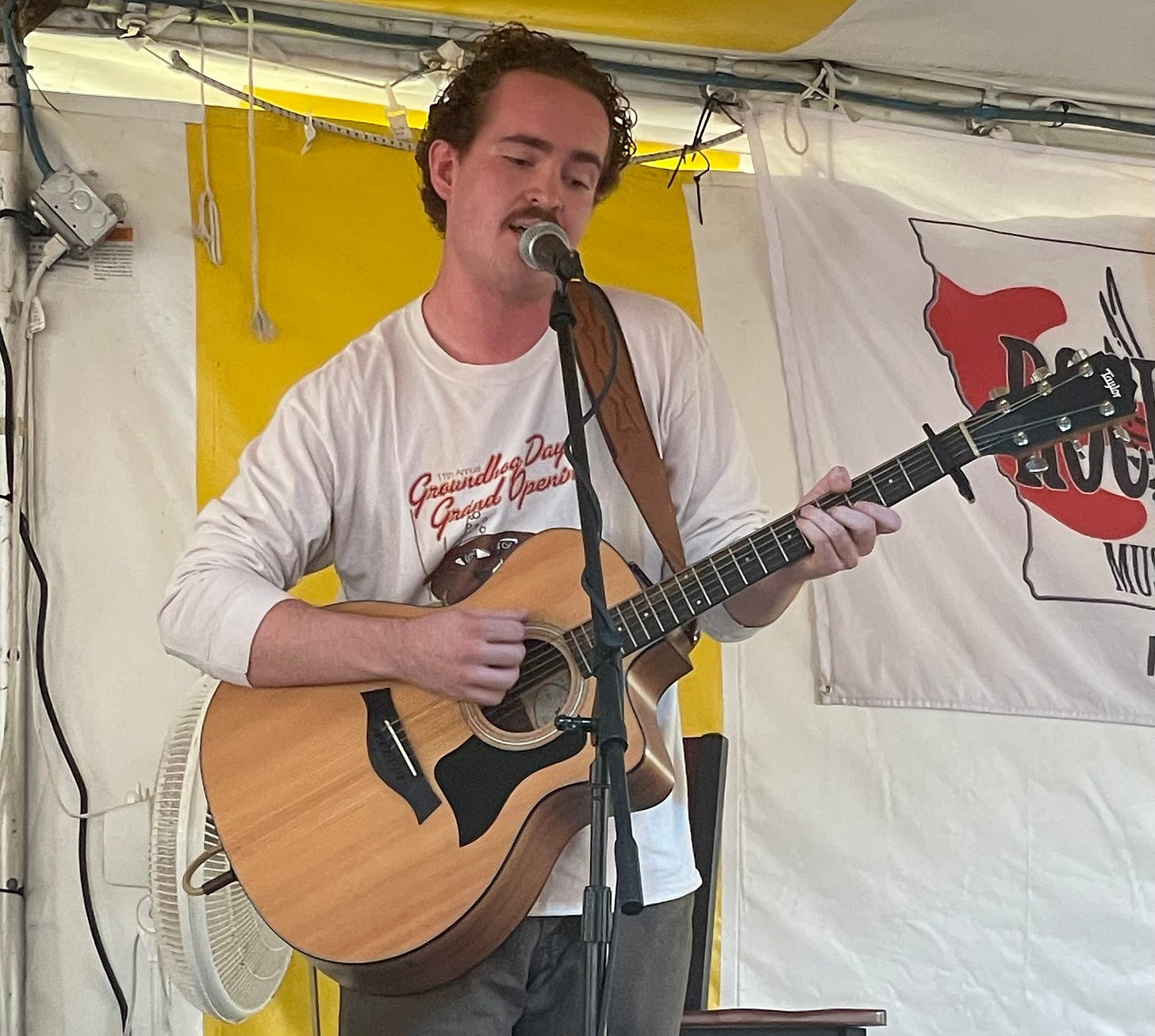
Drew Morelock, 20, of Shenandoah, was the youngest of the musicians in the tribute. He is taking this year off from his musical theater studies at Iowa Western Community College “to work full-time on my songwriting for a while,” he said. Morelock was a leading actor in Shenandoah High School productions like “Disney’s High School Musical” and “Guys & Dolls,” and has already won two young artists’ competitions at the Iowa Rock ‘n’ Roll Music Foundation’s Hall of Fame Weekends. “I did not know Bill Hoover,” young Morelock told the memorial crowd, “but I think you can get to know musicians through their music, even after they’re gone.”
—
You can comment on this column below or write the columnist directly by email at chuck@offenburger.com.


What a lovely tribute to a very special man. To this day I regret not catching his performance when he was in Paris.